Ashish Singh
The Buddha Speaks: Tracing the First Sermon at Sarnath
January 16, 2026
Introduction Sarnath is a quiet town nestled amidst the bustling plains of Uttar Pradesh at a distance of merely 10 kilometres from Varanasi. The place occupies unparalleled spiritual importance among…
Introduction
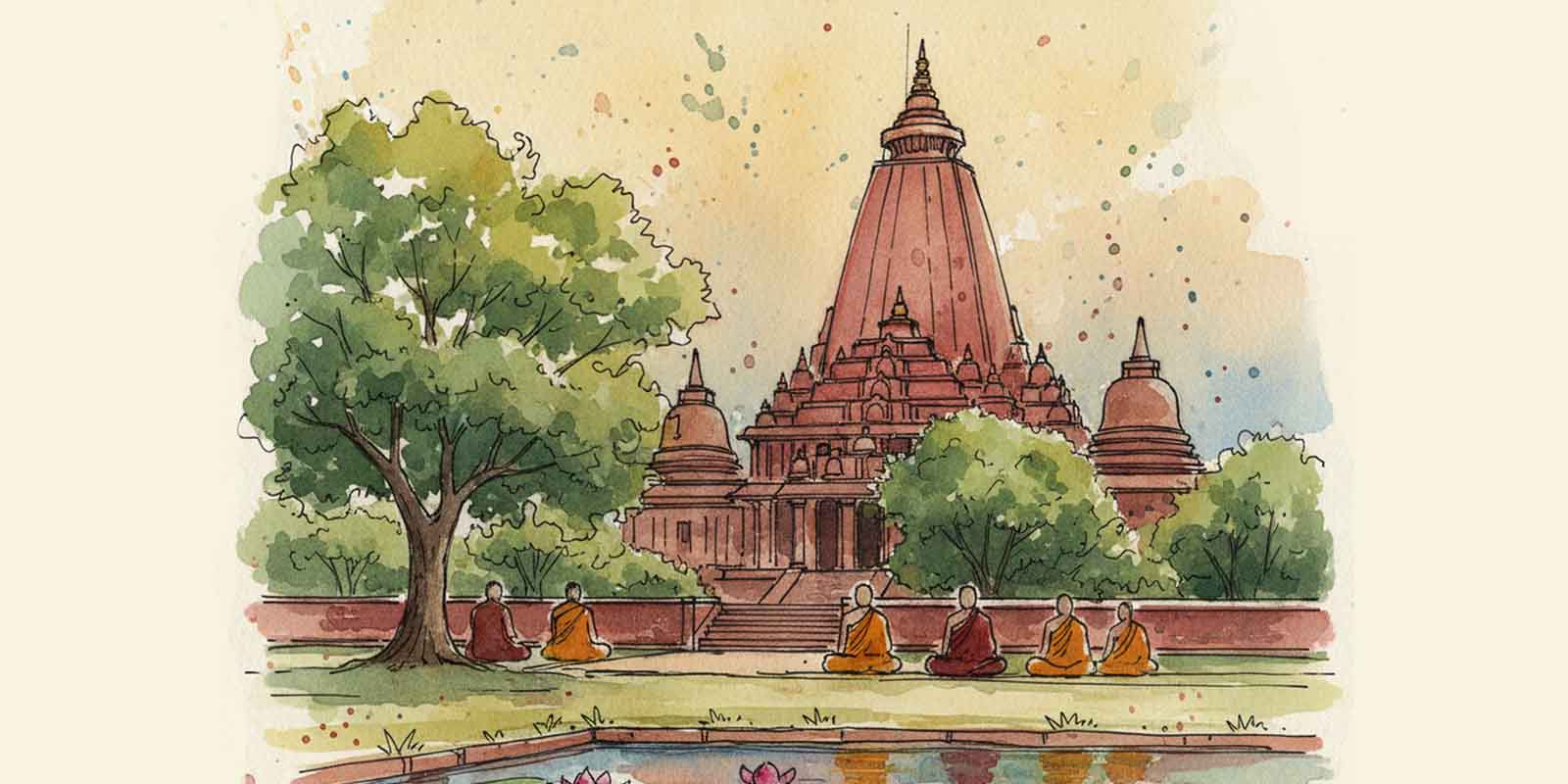
Sarnath is a quiet town nestled amidst the bustling plains of Uttar Pradesh at a distance of merely 10 kilometres from Varanasi. The place occupies unparalleled spiritual importance among the four holiest Buddhist pilgrimage sites. Sarnath was the site where Buddha gave his first sermon to five ascetics, transforming his personal awakening into universal doctrine. It is at this very site where Dhammacakkappavattana or the turning of the Wheel of Dharma was initiated.
At Sarnath, ancient stupas, monastic ruins, polished Ashokan pillars, serene temples, collectively narrate the story of Buddhism’s earliest formation. Sarnath is a living site of memory and devotion where monks, devotees, scholars, and travelers from across Asia gather to meditate, chant, and reconnect with the Buddha’s original teaching. The cultural and spiritual importance of Sarnath is also rooted in its evolution as a major center of Buddhist learning. For centuries, monasteries flourished here, and students from China, Japan, Tibet, Myanmar, and Sri Lanka travelled to Sarnath to study the Dharma. Modern temples built by countries such as Thailand, Japan, Tibet, China, and Sri Lanka add international colour to the sacred environment. Every monastery echoes the timeless message of the Middle Path.
To stand in Sarnath is to witness the source of a universal movement that changed the world through insight and compassion. For travelers seeking meaning, for pilgrims tracing the Buddha’s footsteps, or for students exploring the foundations of Buddhist philosophy, Sarnath offers a uniquely transformative environment. It is not merely a destination but a mental space where one can pause, breathe and reflect.
History and Significance of Sarnath
1. Sarnath in Ancient Buddhist Texts
The town of Sarnath was known as Isipatana in the Pāli texts and Rishipattana in the ancient period. According to the Vinaya Pitaka and Samyutta Nikaya, the Buddha traveled from Bodh Gaya to Isipatana after attaining enlightenment. Here, he encountered five ascetics, Kondanna, Vappa, Bhaddiya, Mahanama, and Assaji, who had previously abandoned him. Recognizing the Buddha’s transformed presence and enlightened state, they listened attentively as he delivered his first sermon.
This sermon, known as the Dhammacakkappavattana Sutta, became the foundational teaching of Buddhism. It explained the Four Noble Truths and the Noble Eightfold Path, establishing the philosophical structure of the Buddhist tradition.
2. The First Sermon and the Birth of the Sangha
The Buddha’s arrival at Sarnath marks a crucial moment in the history of Buddhism. After 49 days of intense meditation under the Bodhi Tree, the Buddha sought a place to share his knowledge with the rest of the world. He chose Sarnath because the five ascetics were spiritually mature and capable of understanding the profound truth. They had also meditated with him earlier and were deemed worthy of grasping the middle path. The First Turning of the Wheel of Dharma transformed the Buddha from a realized sage into a teacher. It established the first community of monks (the Sangha). When Kondanna attained the “eye of Dhamma” after hearing the sermon, he became the first monk. This moment marked the beginning of Buddhism as a living tradition. The sermon delivered at Sarnath is known as the Dhammacakkappavattana Sutta, meaning “Setting in Motion the Wheel of Dharma.” The four noble truths emphasized by Buddha are
- Dukkha – Life contains suffering, dissatisfaction, and instability.
- Samudaya – Suffering has a cause: craving fuelled by ignorance.
- Nirodha – The cessation of suffering is possible.
- Magga – The cessation is achieved through the Noble Eightfold Path.
He also emphasized on the noble eight-fold path:
- Right View
- Right Intention
- Right Speech
- Right Action
- Right Livelihood
- Right Effort
- Right Mindfulness
- Right Concentration
3. Ashoka and the Rise of Sarnath as a Pilgrimage Center
Mauryan emperor Ashoka embraced Buddhism after the brutal bloodshed of the Kalinga war. He transformed Sarnath into a major pilgrimage destination during the 3rd century BCE. Deeply moved by the Buddha’s teachings, Ashoka visited Sarnath and commissioned- a monolithic polished sandstone pillar, several stupas marking key events, monasteries and rest houses for monks. The remains of the Ashokan Pillar, bear inscriptions emphasizing non-violence and moral discipline. The original capital of this pillar, the four majestic lions back-to-back is now revered as India’s national emblem.
5. Decline and Rediscovery
With the decline of Buddhism in India after the 12th century CE, Sarnath’s monasteries were abandoned, damaged, or destroyed during waves of invasion. The site fell into ruins. The 19th-century rediscovery led by Sir Alexander Cunningham and the Archaeological Survey of India transformed Sarnath. Excavations revealed:
- The Dhamek Stupa
- Monastic ruins
- The original Ashokan Pillar fragments
- Terracotta plaques
- Gupta sculptures
- Brahmi inscriptions
These discoveries restored Sarnath’s status as a historical and spiritual treasure.
7. Sarnath in the Modern Era
Today, Sarnath is a global pilgrimage destination visited by monks, scholars, and travelers from across Asia. Modern monasteries built by Thailand, Japan, China, Myanmar, and Tibet provide a cosmopolitan spiritual atmosphere. Annual ceremonies, teachings by international Sanghas, chanting programs, and meditation sessions reinforce Sarnath’s living Buddhist identity. The government of India and international Buddhist communities continue to preserve and develop the site, ensuring that its sacred heritage remains vibrant.
Major Buddhist Sites in Sarnath
- Dhamek Stupa
The Dhamek Stupa is the most monumental site of Sarnath. It marks the exact spot where the Buddha delivered his First Sermon and “set in motion the Wheel of Dharma.” The stupa is 43 meters in height. It is cylindrical in shape and built of stone from the Mauryan period. Its finely carved stone base is decorated with lotus motifs, geometric patterns, and flowing vine designs. For centuries, monks and pilgrims from across Asia have circumambulated this structure, chanting sutras and offering prayers. Even today, the Dhamek Stupa radiates a spiritual gravity. Standing before the stupa, visitors experience the profound realization that the foundational ideas of Buddhism-the Four Noble Truths, the Middle Way, and the Noble Eightfold Path were first taught on this very ground, making the Dhamek Stupa not just a relic of history but a timeless symbol of awakening and the birth of Buddhist philosophy.
2. Chaukhandi Stupa
The Chaukhandi Stupa marks the place where the Buddha first met the five ascetics Kondanna, Bhaddiya, Vappa, Mahanama, and Assaji after attaining enlightenment. It has an octagonal Islamic-style tower which was built in the 16th century by Mughal governor Govardhan. This stupa represents the moment when Buddha reunited with his disciples who would become the first monks. The brick mound core of the stupa reflects the architecture of the Gupta period. The striking octagonal tower on top was added in the 16th century by Mughal governor Govardhan on behalf of Emperor Akbar to commemorate Humayun’s visit to the site. Today, pilgrims visit the stupa to reflect on the pivotal encounter of Buddha with the five ascetics, circumambulating the mound and experiencing the quiet landscape that once witnessed the beginning of the Buddha’s role as teacher. The stupa’s elevated position, surrounded by open fields and pathways, adds a sense of solemnity, reminding travelers that this is the ground where the Sangha’s history truly began.
3. Mulagandha Kuti Vihara
The Mulagandha Kuti Vihara was built by the Mahabodhi Society under Anagarika Dharmapala. This temple is renowned for its striking golden Buddha statue and the extraordinary frescoes. The temple is located where the Buddha spent his first monsoon retreat after enlightenment. It was built to revive the sanctity of the ancient monastic complex where the Buddha spent his first rainy season retreat and continued teaching the five ascetics. Although the original hut (kuti) used by the Buddha no longer exists, this contemporary monastery is designed to symbolically preserve that legacy through its serene architecture, meditative environment, and rich artistic expression. Its most striking feature is the series of exquisite frescoes painted by the renowned Japanese artist Kosetsu Nosu, which vividly depict key moments from the Buddha’s life-from his birth to enlightenment and teaching. The vihara also enshrines a sacred relic of the Buddha, making it an important pilgrimage destination for Buddhists worldwide. Surrounded by quiet gardens and tall Bodhi trees, the complex offers a tranquil atmosphere where chanting, meditation, and evening prayers create a living spiritual energy often described as the “heartbeat” of modern Sarnath.
4. Ashokan Pillar
The Ashokan Pillar at Sarnath is one of the most significant relics in India. The original lion capital atop this pillar, now preserved in the museum, is India’s national emblem. The Ashokan Pillar was erected by Emperor Ashoka in the 3rd century BCE during his extensive campaign to preserve places associated with the Buddha’s life. The pillar was originally made of polished sandstone. Although the pillar has broken over time and only the base remains at the original site, its craftsmanship still reflects the precision and refinement of Ashokan architecture. There is an inscription written in early Brahmi script that emphasize moral conduct, non-violence, respect for all sects, and discipline within the Sangha. The Lion Capital, now housed in the Sarnath Museum, features four majestic lions standing back to back atop a wheel (Dharmachakra) and lotus base, symbolizing the spread of the Buddha’s teachings in all directions. This sculpture is considered one of the greatest masterpieces of ancient Indian art. Today, the Ashokan Pillar remains a powerful link between history and pilgrimage, reminding visitors that Sarnath’s sanctity was recognized and protected by one of the greatest patrons of Buddhism more than 2,200 years ago.
5. Sarnath Museum
The Sarnath Museum is the oldest site museum established by the Archaeological Survey of India. It houses the most important discoveries made during excavations at Sarnath between the late 18th and early 20th centuries. Its collection showcases objects that directly shaped our understanding of Buddhist history in India. The museum’s most celebrated treasure is the Lion Capital of Ashoka, the original crowning piece of the Ashokan pillar that once stood in Sarnath. Carved from a single block of polished sandstone, the sculpture features four lions back-to-back, symbolizing the Buddha’s voice spreading across the world. Beneath them lies the Dharmachakra, the bull, the horse, the lion, and the elephant-each representing different phases of the Buddha’s life and the spread of Dharma. The museum also houses an extraordinary range of sculptures from the Mauryan, Kushan, and Gupta periods. You will also find fragments of the Dharmarajika Stupa, intricately carved railing pillars, Bodhisattva images, votive stupas, seals, inscriptions, and everyday items used by monks who lived at Sarnath more than 2,000 years ago. Each gallery traces a different phase of Buddhist history, allowing travelers to visually follow the evolution of Buddhist art from simple symbolic motifs to sophisticated sculptures.
6. International Monasteries
There are many monasteries built by Thailand, Myanmar, Japan, Tibet, Vietnam, and Sri Lanka.
- Hinayana Buddha temple- This Thai monastery was built in 1933. It features a statue of a laughing Buddha and an enactment of Buddha delivering a sermon to his disciples. There are three other statues of Buddha in various mudras.
- Sri Lankan Monastery- It is built in traditional Sinhalese style with white walls and a domed stupa, this monastery emphasizes purity and simplicity.
- Tibetan Monastery- It was constructed in 1955 and is the first monastery and temple built by the present Dalai Lama in India.
- Japanese Temple- This temple has a statue of the Buddha in a calm pose beneath a tree.
- Myanmar Buddhist Vihara -It reflects Myanmar’s Theravada culture. Inside, a standing Buddha and meditation halls support an active schedule of chanting and retreats.
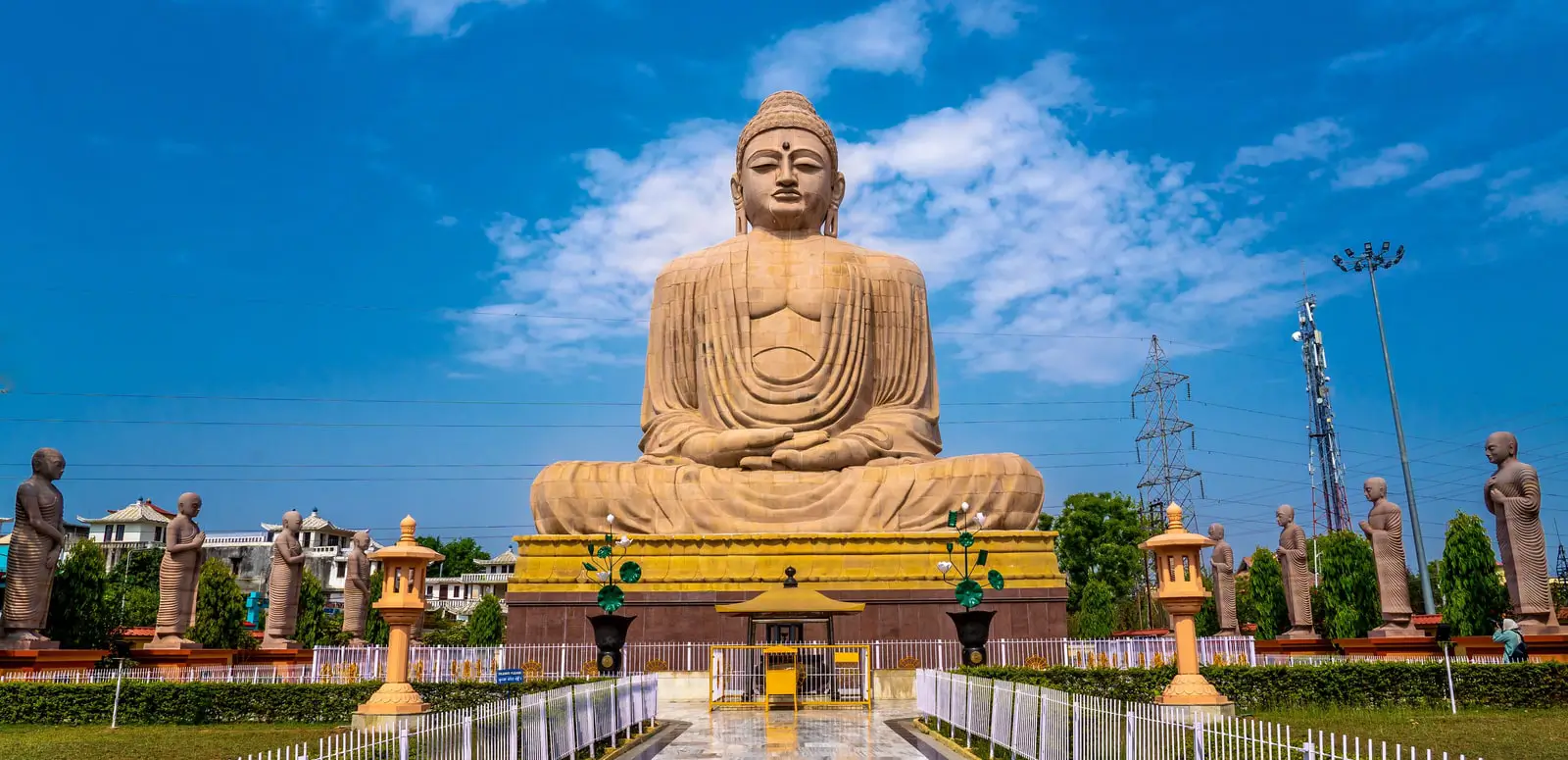
- Sivali Vietnamese Buddhist Temple - The monastery reflects a gentle blend of Mahayana and Zen aesthetics. The temple has a 70-foot-tall giant statue of meditating Buddha
What to Do in Sarnath
- Meditate near the Dhamek Stupa, where the Buddha delivered his first sermon.
- Walk the archaeological grounds to understand the layout of ancient monastic universities.
- Observe chanting sessions by monks from different traditions.
- Visit the Sarnath Museum to view exceptional Buddhist sculptures.
- Explore modern monasteries to witness how global traditions interpret the Dharma.
- Attend teaching sessions or guided meditation programs.
- Experience sunrise or sunset at the Deer Park for a reflective spiritual ambiance.
How to Reach Sarnath
- By Air: Varanasi International Airport (27 km away).
- By Train: Varanasi Junction is well-connected to major Indian cities.
- By Road: Regular taxis, autos, and buses operate between Varanasi and Sarnath.
Best Time to Visit
The ideal months to visit Sarnath are October to March, when the weather is cool, pleasant, and ideal for exploring archaeological sites and attending outdoor meditation sessions.
Tips for Travellers
- Dress modestly when visiting monasteries and temples.
- Maintain silence at stupas and meditation zones.
- Allocate at least half a day to explore the museum and archaeological complex.
- Visit early morning or late afternoon for minimal crowds.
- Carry water, as the archaeological park is large and open.
- Check schedules for meditation programs or chanting ceremonies.
Trace the Buddha’s earliest footsteps with Buddhist Tour
Plan your transformative journey to Sarnath with BuddhistTour.com, your trusted companion for curated pilgrimages, guided monastery visits, and meaningful spiritual travel across India’s Buddhist circuit., deepen your understanding, and experience the timeless wisdom of the Dharma.